

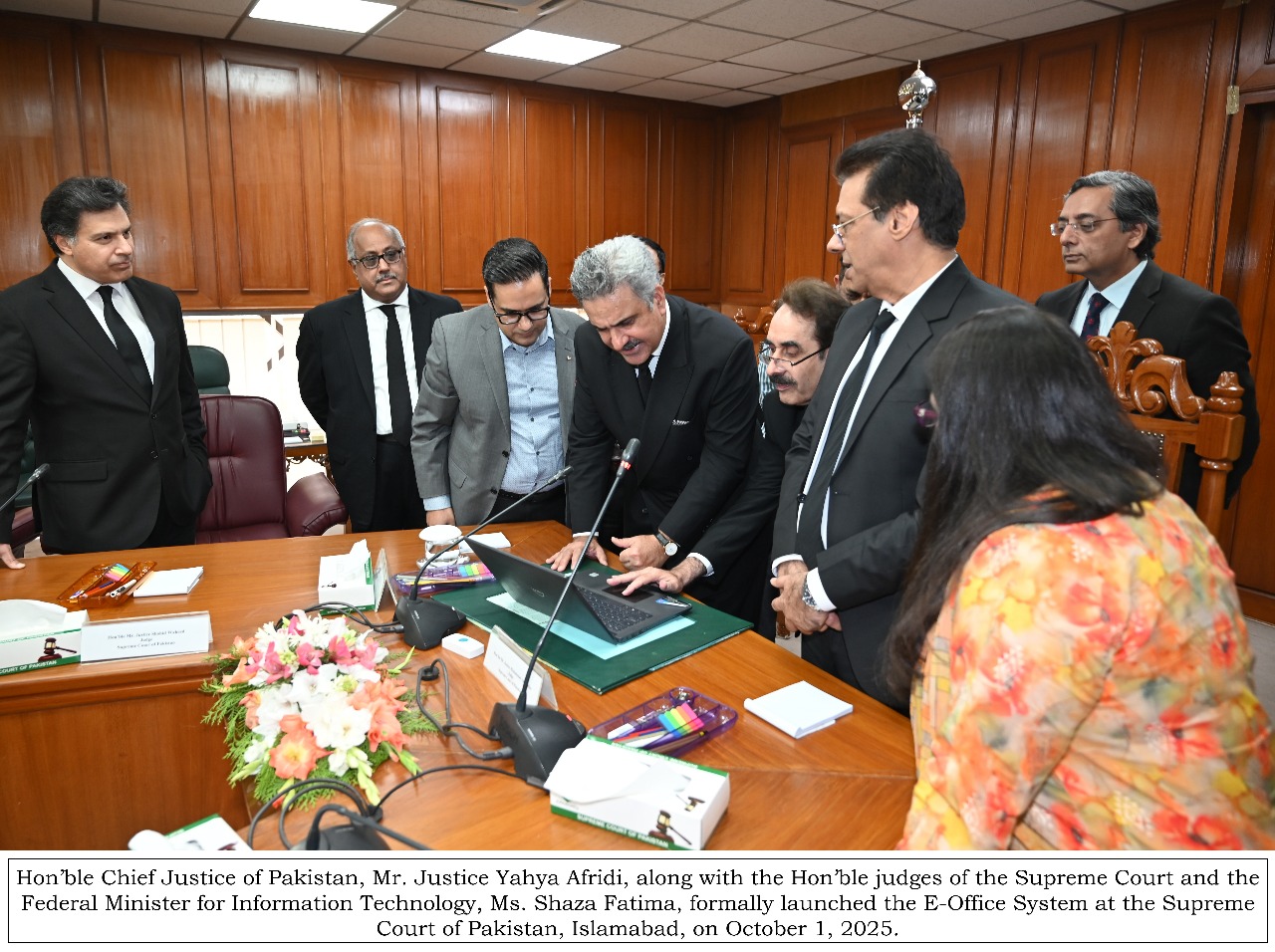
Islamabad, October 1, 2025 – The Supreme Court of Pakistan today hosted a landmark event aimed at advancing digital transformation in the justice sector: the signing of a Memorandum of Understanding (MoU) between the Law and Justice Commission of Pakistan (LJCP) and the National Information Technology Board (NITB), and the formal launch of the E-Office system in the Supreme Court.
The ceremony was graced by Hon’ble Mr. Justice Yahya Afridi, Chief Justice of Pakistan; Ms. Shaza Fatima Khawaja, Federal Minister for Information Technology and Telecommunication; Hon’ble Mr. Justice Muhammad Ali Mazhar, Chairman, National Judicial Automation Committee (NJAC); Hon’ble Mr. Justice Shahid Waheed, Judge Supreme Court of Pakistan; Hon’ble Mr. Justice Miangul Hassan Aurangzeb, Judge Supreme Court of Pakistan; and Mr. Zarrar Hasham Khan, Federal Secretary, Ministry of Information Technology and Telecommunication. However, Hon’ble Mr. Justice Ali Baqar Najafi, Judge Supreme Court attended event online from Lahore.
The MoU was signed by the Secretary, Law and Justice Commission of Pakistan, and the Chief Executive Officer, NITB. The agreement provides for the joint development of an Analytical Dashboard for the Judiciary—a digital platform that will consolidate judicial data, integrate information from across the justice sector, and incorporate monitoring parameters of the National Judicial (Policy Making) Committee (NJPMC). The dashboard will allow real-time tracking of case disposal rates, backlog trends, and institutional efficiency, supporting evidence-based policy making, performance-driven reforms, and enhanced transparency.
Following the signing, the E-Office system was formally launched in the Supreme Court of Pakistan, marking another significant step toward digitalization. The system will digitize all file movement and office work, while a dedicated case management system for the Hon’ble Judges of the Supreme Court will soon be introduced. Together, these initiatives herald the shift towards a more efficient, paperless, and technology-driven judicial process.
These reforms represent a major stride in the digital transformation of Pakistan’s justice system, reflecting the judiciary’s strong commitment to modernization, innovation, and public accountability. By harnessing technology, the justice sector will be better positioned to meet contemporary challenges, ensure timely access to justice, and strengthen public trust in the judicial process.