
SUPREME COURT OF PAKISTAN
PRESS RELEASE
THE NATIONAL JUDICIAL (POLICY MAKING) COMMITTEE
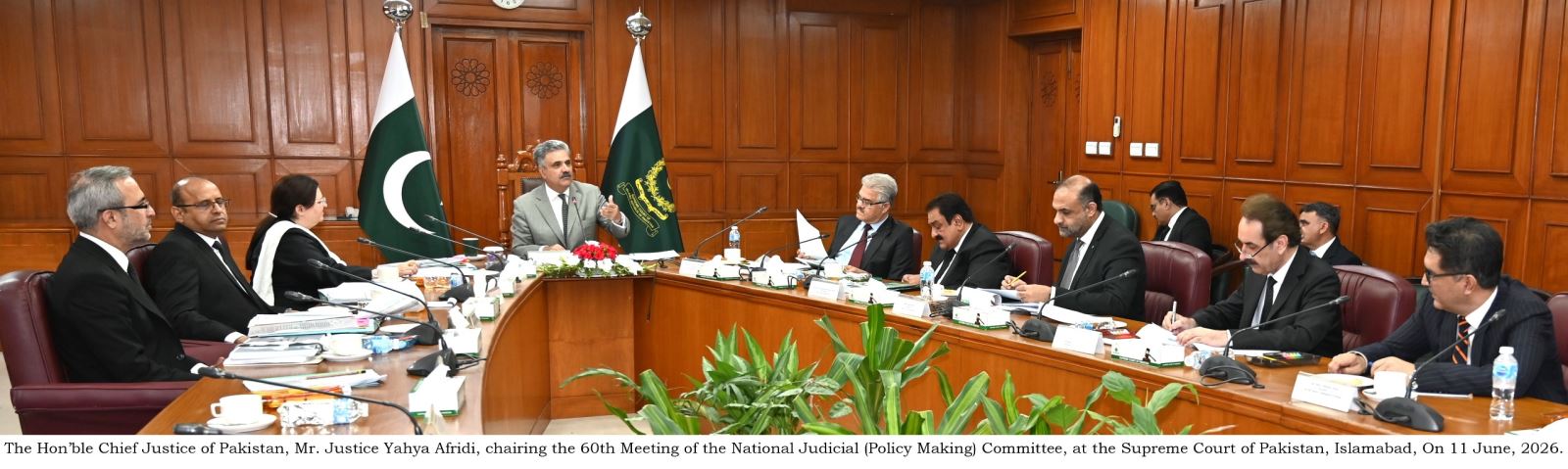
Islamabad, June 11, 2026 - Hon’ble the Chief Justice of Pakistan chaired the 60th meeting of the National Judicial (Policy Making) Committee (NJPMC), today at the Supreme court of Pakistan. The meeting was attended by Hon’ble the Chief Justice, Lahore High Court, Hon’ble the Chief Justice, Peshawar High Court, Hon’ble the Chief Justice, High Court of Sindh and Hon’ble Senior Puisne Judge, Islamabad High Court. The Secretary, Ministry of Law and Justice and the Chairman, Higher Education Commission attended the meeting on special invitation.
The Committee deliberated on key policy issues, while reviewing implementation status of the decisions taken in its 59th meeting. The Committee unanimously reiterated its resolve to strengthen institutional capacity, accelerate access to justice, and ensure efficient and effective justice delivery.
The following decisions were taken unanimously;
I. Institutional Response on Cases of Enforced Disappearances
DECISION:- The Secretary, Ministry of Law and Justice apprised the Committee that the Government has, in principle, agreed to establish a separate Commission comprising Hon’ble Mr. Justice (Retd) Manzoor Ahmad Malik, former Judge of the Supreme Court of Pakistan and the Chairperson of the National Commission for Human Rights Ms. Rabiya Javeri Agha for providing redressal mechanism, ensuring implementation of Section 11 EEEE of the Anti-Terrorism Act, 1997, requiring production of arrested person before the Court within twenty-four hours. It was also apprised that the Terms of Reference of the Commission are yet to be finalised.
- The NJPMC highly appreciated the measures taken by the Government with regard to cases of missing persons and desired that the detailed Terms of Reference of the proposed Commission be placed before the Committee in its next meeting.
II. Disposal of Time-bound Categories of Cases
DECISION:- The NJPMC appreciated the performance of the High Courts in ensuring expeditious disposal of prioritized categories of cases, including chronic and old cases, in accordance with the prescribed timelines.
- The NJPMC noted that during the period from 01 September 2025 to 31 May 2026, the District Courts demonstrated significant progress in the disposal of prioritized categories of cases notified under the NJPMC timelines regime.
- Collectively, the District Courts disposed of 1,319,390 cases, reflecting sustained efforts towards reduction of backlog and timely adjudication. The Lahore High Court recorded the highest disposal with 1,065,375 cases, followed by the Peshawar High Court with 123,051 cases, the High Court of Sindh with 87,219 cases, the Islamabad High Court with 27,465 cases, and the High Court of Balochistan with 16,280 cases. The significant disposal figures indicate the commitment of the judiciary towards time-bound expeditious resolution of prioritized categories of cases.
| PROVINCE-WISE BREAK UP OF DISPOSAL | ||
|---|---|---|
| Punjab | Reported Pendency | 904,750 |
| Disposal up to 30/5/2026 | 1,065,375 | |
| Disposal % wrt. Reported Pendency | 118% | |
| Sindh | Reported Pendency | 128,794 |
| Disposal up to 30/5/2026 | 87,219 | |
| Disposal % wrt. Reported Pendency | 68% | |
| Khyber Pakhtunkhwa | Reported Pendency | 133,662 |
| Disposal up to 30/5/2026 | 123,051 | |
| Disposal % wrt. Reported Pendency | 92% | |
| Balochistan | Reported Pendency | 15,331 |
| Disposal up to 30/5/2026 | 16,280 | |
| Disposal % wrt. Reported Pendency | 106% | |
| ICT | Reported Pendency | 36,511 |
| Disposal up to 30/5/2026 | 27,465 | |
| Disposal % wrt. Reported Pendency | 75% | |
| Total | Reported Pendency | 1,219,048 |
| Disposal up to 30/5/2026 | 1,319,390 | |
| Disposal % wrt. Reported Pendency | 108% | |
III. Performance of Model Trial Courts
DECISION:The NJPMC expressed satisfaction over the encouraging performance of the Model Civil and Criminal Trial Courts in reducing backlog by improving the disposal rate of civil and criminal cases. While appreciating disposal pace, the Committee reiterated evidence-based performance monitoring to ensure accountability, sustainability and quality assurance of adjudications.
Cases Decided by the Model Criminal and Civil Courts (16-03-2026 to 31-05-2026)
| High Court | Civil Cases Disposal | Criminal Cases Disposal |
|---|---|---|
| Lahore High Court | 4705 | 5648 |
| High Court of Sindh | 750 | 3117 |
| Peshawar High Court | 376 | 3022 |
| High Court of Balochistan | 2526 | 3594 |
| Islamabad High Court | 169 | 1185 |
| Total | 8526 | 16566 |
IV. Discouraging False and Frivolous Litigation
DECISION:- The NJPMC appreciated the efforts of the Committee headed by the Hon’ble Chief Justice, High Court of Balochistan for developing a comprehensive legislative and policy framework to discourage false and frivolous litigation, drawing upon the principles provided in the Cost of Litigation Act, 2017 (ICT).
- The NJPMC directed the LJCP Secretariat to circulate the proposed framework to all the High Courts for consideration and further action.
V. Administrative reforms to ensure expeditious and cost-effective adjudication of banking cases/disputes
DECISION:- The NJPMC considered the proposals emerging from the stakeholders’ consultation convened by the Hon’ble Chief Justice of Pakistan/Chairman, LJCP. After deliberations, the Committee approved the following administrative measures to facilitate expeditious and cost-effective adjudication of banking cases and disputes:
- The High Courts shall review the workload of existing Banking Courts and, where necessary, consider establishment of additional Banking Courts to reduce pendency and ensure timely disposal of cases.
- The High Courts shall arrange specialized training programmes for Judges of Banking Courts, in collaboration with the Judicial Academies to enhance their capacity in banking laws, financial regulations and banking litigation.
- For effective utilization of expertise, the High Courts may consider fixation of tenure for Judges of the Banking Courts.
- The Banking Courts should ensure strict adherence to the statutory provisions governing stays/injunctions and decide the cases with the timelines prescribed under the Financial Institutions (Recovery of Finances) Ordinance, 2001.
- Banking Courts shall effectively apply the provisions relating to costs to discourage frivolous litigation and unnecessary delay in proceedings.
- For performance monitoring, the High Courts may put in place a robust oversight mechanism to promote efficiency and accountability.
- The High Courts shall apprise the NJPMC for efforts made to implement the aforementioned decisions.
VI. Observance of two weekly holidays in the district judiciary
DECISION:- The NJPMC considered the proposals received from the Peshawar High Court and the Lahore High Court seeking reconsideration of the policy of observing three weekly holidays in the District Judiciary. The Committee noted that the policy had been introduced under the Judicial Austerity and Energy Conservation Strategy approved by the NJPMC in its 58th meeting to promote prudent utilization of resources and energy conservation.
- The NJPMC, while appreciating the support by the Federal Government and considering the eased-out situation conveyed through Secretary, Ministry of Law and Justice, decided that the District Judiciary may revert to a six-day working week in accordance with the working schedule that existed prior to the implementation of the Judicial Austerity and Energy Conservation Strategy.
- The Committee, however, desired the High Courts to implement suitable resource management and energy-saving measures while maintaining the smooth and uninterrupted administration of justice.
VII. TABLE AGENDA:
- Specialized Benches to hear Company Cases: The NJPMC positively looked into the issue of hearing of company cases by the specialised benches of the High Courts for disposal and decided that the same would be focused objectively in the backdrop of the pendency.
- Data Integration for National Judicial Analytics Dashboard: The NJPMC observed that the National Judicial Analytics Dashboard is a useful tool for performance monitoring and desired all the High Courts to integrate data regularly for keeping the dashboard updated.
- Diploma Courses for Judicial Officers: The NJPMC desired that specialised short Diploma Course be arranged for Judicial Officers at universities in collaboration with Higher Education Commission and the Judicial Academies. Such courses shall be sponsored jointly by HEC and LJCP.
- Vacant Positions of Judicial Officers in the District Judiciary: The NJPMC highlighted the vacancy position in the District Judiciary and desired that concrete steps should be taken to ensure that the judiciary functions with its full sanctioned strength.
- Conference on Judicial Wellbeing: The NJPMC decided that the National Conference on Judicial Wellbeing shall be held at Supreme court of Pakistan Auditorium on the International Day for Judicial Wellbeing (July 25, 2026) to highlight and acknowledge the contribution of the District Judiciary in ensuring access to justice. It was also decided that the best performing Judicial Officers would be awarded commendation certificates while the Chief Justices of the High Courts shall showcase their reforms intervention.
- Bench-Bar Liaison: In order to make the justice system more responsive and citizen-centric, the NJPMC resolved that Bench-Bar liaison may be further strengthened.
- Standard Operating Procedures on Biometric Verification: The NJPMC appreciated the Lahore High Court for setting in place a robust mechanism for biometric verification. It was desired that the SOPs may be shared with rest of the High Courts for reference as a best practice.
The meeting concluded with an expression of appreciation for the sustained efforts of all High Courts, the Ministry of Law and Justice, and the Secretariat of the Law and Justice Commission of Pakistan for their valuable contributions toward strengthening the administration of justice, fostering institutional coherence, and enhancing public confidence in the judicial system.